


Not all miners experience mining the same way.
Two miners can run identical machines, consume the same amount of electricity, and still see very different results — especially in the short term.
The reason comes down to one factor:
Variance.
And while variance affects everyone, small miners feel it the most.
What Is Variance in Mining?
Mining is fundamentally a probability-based process.
Each hash your machine produces is an attempt to solve the next block. But finding a block isn’t guaranteed — it’s random within a statistical framework.
This leads to uneven outcomes:
- Periods with no rewards
- Sudden payouts
- Fluctuating income over time
This randomness is what we call variance.
Why Small Miners Feel It More
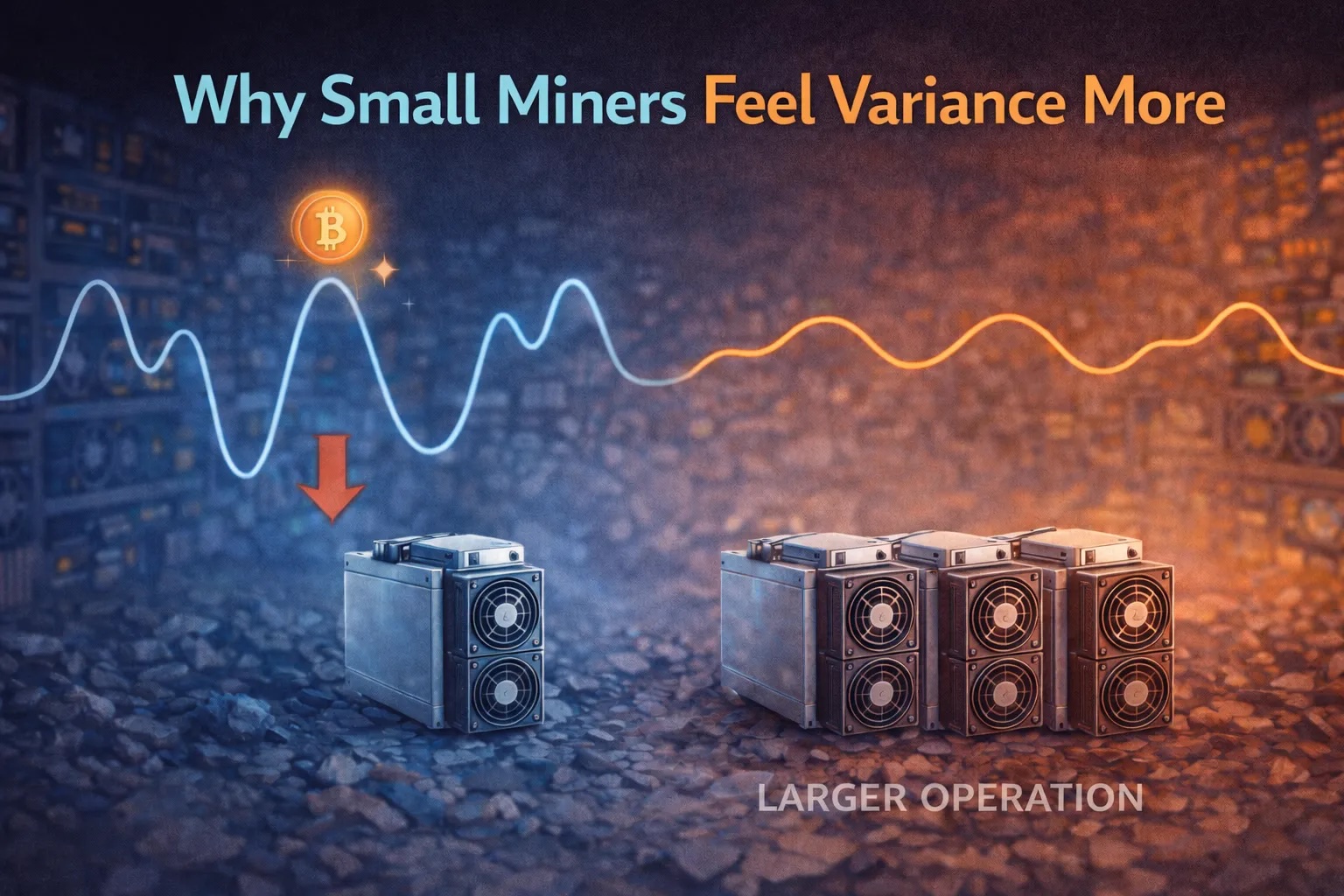
Variance impacts all miners, but the size of your hash rate determines how smooth your experience feels.
A large mining operation with significant hash rate:
- Contributes a consistent portion of total network power
- Receives steady rewards over time
- Can absorb short-term fluctuations
A small miner, on the other hand:
- Has a much smaller share of the network
- Relies more on probability “luck”
- Experiences longer gaps between rewards when mining solo
In simple terms:
The smaller your operation, the more your income feels like a lottery.
The Real Problem: Cash Flow
For small miners, variance isn’t just a mathematical concept — it’s a practical problem.
Electricity bills arrive on schedule.
Hardware costs don’t fluctuate with luck.
Cooling and maintenance are ongoing.
But mining rewards? Not always.
This mismatch creates stress:
- Unpredictable income
- Difficulty covering costs
- Harder decision-making for upgrades or scaling
Reducing variance isn’t about maximizing peaks — it’s about stabilizing the baseline.
How Mining Pools Solve This
Mining pools exist primarily to reduce variance.
By combining the hash rate of thousands of miners, pools create a system where:
- Blocks are found more frequently
- Rewards are distributed proportionally
- Income becomes more predictable
Instead of waiting for a rare solo block, small miners receive:
- Smaller payouts
- Much more frequently
This transforms mining from a high-risk lottery into something closer to a steady revenue stream.
Payout Models Matter
Pools reduce variance — but payout models determine how much.
For small miners, the most relevant models are:
PPS (Pay Per Share)
- Fixed payout for each share
- Maximum stability
- Ideal for predictable income
PPS+ (Pay Per Share Plus)
- Stable base payout + transaction fees
- Balanced approach
PPLNS (Pay Per Last N-Shares)
- Lower fees, but higher variance
- Better suited for larger or long-term operations
For most small miners, PPS or PPS+ provides the smoothest experience, especially when managing tight margins.
Why Pool Choice Matters
Not all pools reduce variance equally.
A well-run pool improves outcomes through:
- Reliable uptime
- Fast share validation
- Low stale share rates
- Accurate and transparent reporting
Even small inefficiencies can matter more for small miners, where every share counts.
This is one reason many miners choose ViaBTC, which offers stable payout models and infrastructure designed to reduce variance for miners of all sizes.
Small Does NOT Mean Inefficient
One of the biggest misconceptions in mining is that small operations are inherently disadvantaged.
In reality, small miners can compete effectively by:
- Choosing the right payout model
- Using reliable pool infrastructure
- Minimizing wasted shares
- Managing costs carefully
The key isn’t size — it’s efficiency and consistency.
Call to Action: Smooth Out Your Mining Income
If you’re a small or home miner, reducing variance is one of the most impactful changes you can make.
Mine with ViaBTC and benefit from stable payout models and infrastructure designed to turn unpredictable rewards into consistent income.
Mining doesn’t have to feel like a lottery — when variance is managed, it becomes a strategy.